When might USCIS need a translated divorce decree?
A foreign divorce record may be part of the evidence used to document the end of a previous marriage. For a petition for a spouse, 8 CFR 204.2(a)(2) calls for proof of the legal termination of both parties’ previous marriages.
That evidence requirement and the language requirement are separate questions. First identify the record your application requires. Then arrange a translation if the record you will submit contains foreign-language text. Follow current form instructions and any case-specific request; not every applicant needs a divorce record.
If you are unsure whether you have the correct decree, a final record, or sufficient evidence of termination, ask an immigration attorney or an authorized accredited representative. A translator can describe the text and prepare the translation, but cannot decide your filing strategy.
What are the USCIS translation requirements?
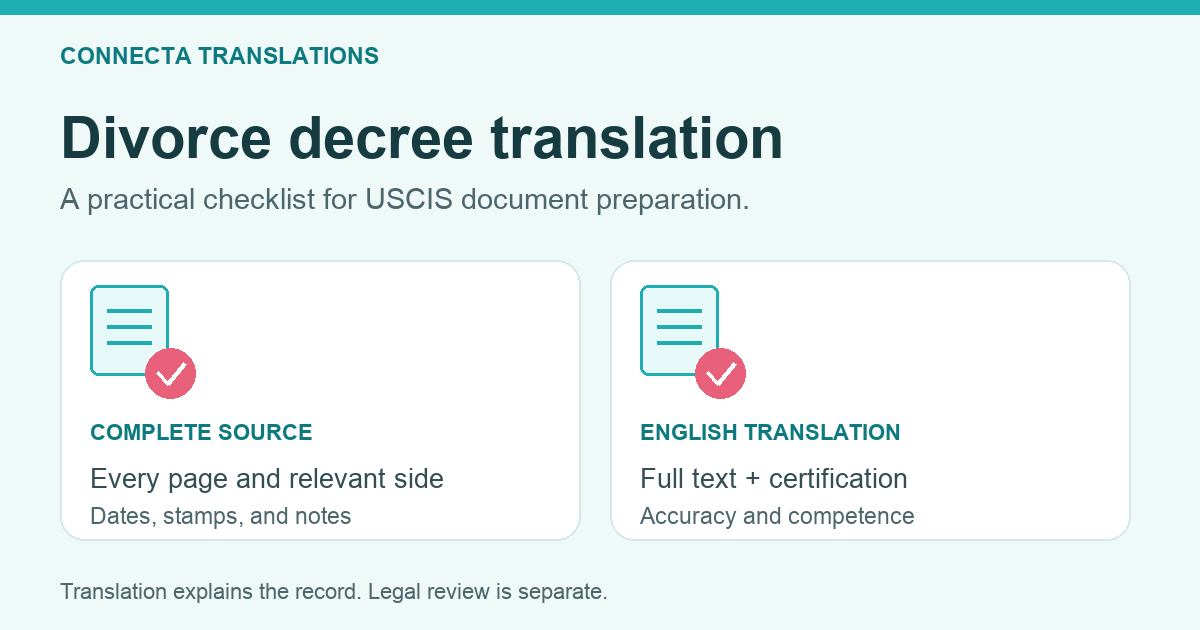
8 CFR 103.2(b)(3) requires a full English translation of a document containing foreign language submitted to USCIS. The translator must certify completeness and accuracy and competence to translate from the source language into English.
The general rule does not add a requirement for notarization or ATA certification. Do not confuse a translation certification with a court-certified copy of the underlying decree. One addresses the language work; the other concerns the source record.
The American Translators Association’s certification guidance recommends identifying the document and languages and including the signer’s name, signature, and date, along with the relevant statements. Treat those professional recommendations separately from the wording of the federal rule. For a closer comparison, read Certified vs. Notarized Translation.
Do all pages, seals, and handwritten notes need attention?
Arrange translation of the full document you are submitting, rather than a self-selected summary. Give the translator every page and relevant reverse side so headings, text, seals, stamps, endorsements, and handwritten notes can be assessed.
A long decree may contain material that seems unrelated to your current application. Do not remove pages just to reduce translation costs. If you think a different official record could be appropriate, ask your legal adviser which document to obtain before ordering the translation.
Make a page inventory that includes:
- The decree’s first page and every continuation page.
- Signature and certification pages belonging to the record.
- Reverse-side notes and later endorsements.
- Attachments included in the document package you intend to submit.
For example, a hypothetical four-page decree with a stamped reverse side gives the translator five sides to inspect. Identify the stamp when requesting a quote instead of assuming it can be omitted.
What if a name, date, or court stamp is unclear?
Provide a clearer source when possible and identify the uncertain location in a separate note. Do not edit the original scan or supply a guessed reading as if it were confirmed.
Names may appear differently across records, and a court document may contain several dates. Ask the translator to preserve those distinctions. The date an order was signed, a date shown in an endorsement, and a date described as effective should not be silently collapsed into one date.
A practical review note might say: “Page 3, lower-right stamp is faint. I can request a clearer copy. Please let me know what can be read.” Ask the provider how unresolved illegibility will be represented. A translation should not fill a missing line with an assumption.
If the source itself contains an error, ask the issuing authority or your adviser about the proper correction process. A translator’s wording cannot repair the legal record.
Does translating the decree prove the divorce is valid?
No. A faithful translation explains the record’s content. It does not determine whether the issuing authority had jurisdiction, whether the divorce is recognized for your application, or whether additional evidence is needed.
Keep two review tracks separate: the provider reviews the language work, and your legal adviser addresses the document’s legal significance. If a term about finality or effectiveness is unfamiliar, request an accurate translation and bring the question to your adviser.
Also avoid ordering an apostille simply because the record was issued abroad. Ask what your particular submission requires. Connecta’s guide to certified translation versus apostille explains the different purposes, without treating authentication as a substitute for translation or legal review.
What should you check before submitting the finished package?
Check that the translation covers the intended source record and includes the agreed certification. Review any discrepancy with the provider before submitting it, and keep the certified version intact.
| Review item | What to check |
|---|---|
| Document coverage | Every intended page, reverse side, and attachment was assessed |
| Identity details | Names and case numbers correspond to the source |
| Dates | Distinct dates and their labels remain clear |
| Unclear text | Any unresolved passage is addressed transparently |
| Certification | Completeness, accuracy, and translator competence are certified |
| Delivery and filing | The format matches the current submission instructions |
Do not type your own corrections into a signed translation. Send the concern to the provider so any revision and certification can be handled together. Keep the source copy, final translation, and relevant instructions organized as one package.
How do you request a divorce decree translation from Connecta?
Start with Connecta’s immigration translation services or certified translation services, then request a quote. State the source language, English target language, page inventory, recipient, delivery needs, and deadline. Confirm the appropriate method for providing sensitive files.
Ask Connecta to confirm the scope, certification, cost, and expected completion date after reviewing the record. This guide makes no acceptance or turnaround guarantee. If your application also includes a marriage record, the marriage certificate translation guide can help you organize that separate document.
Clients in Bradenton, Sarasota, Lakewood Ranch, and elsewhere can use the document preparation checklist to make the initial request more complete.
Frequently asked questions
Does USCIS need a full translation of a foreign-language divorce decree?
A document containing foreign language submitted to USCIS must be accompanied by a full English translation with the certifications required by 8 CFR 103.2(b)(3). Do not substitute a summary for the full translation of the document you submit.
Does the translation need to be notarized?
The general USCIS translation rule does not require notarization. Follow current application instructions and any case-specific request, and distinguish translation certification from certification of the underlying court record.
Can a translator determine whether my divorce is legally final?
A translator can accurately convey what the record says. Questions about legal finality, recognition, and the evidence needed for your application should go to a qualified legal adviser.
Can I omit pages about property or other private matters?
Do not cut pages from the document you plan to submit and ask for only a summary. If you want to use a different official record, ask your adviser which record is appropriate before ordering the translation.
Sources and editorial note
Official and professional sources checked October 26, 2026. Checklists and examples are practical editorial guidance. Confirm current requirements with the receiving office.