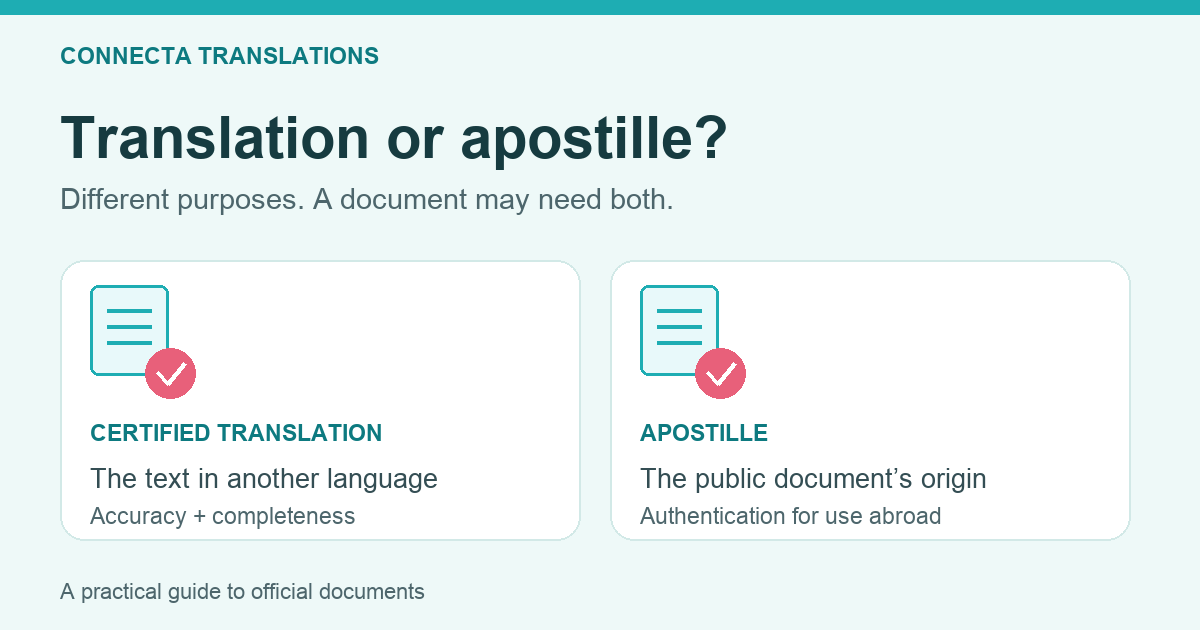
What is the difference between a certified translation and an apostille?
A certified translation concerns the language and accuracy of the translated text. An apostille concerns the public document’s origin, including the relevant signature, the signer’s official capacity, and, where applicable, its seal or stamp. One does not replace the other.
The American Translators Association explains translation certification. The HCCH’s explanation of an apostille’s effects makes clear that it does not certify the underlying document’s contents.
| Step | What it addresses | What it does not establish |
|---|---|---|
| Certified translation | Accuracy and completeness of the text in another language | Government authentication of the source document |
| Apostille | The origin of an eligible public document | Translation accuracy or approval of the document’s contents |
Can an apostille replace the translation?
No. An apostille does not turn an English document into Spanish, or make a Spanish document readable in English. If the receiving office requires a translation, you still need to meet that language requirement.
For example, imagine a person sending an English-language record to an overseas office that asks for both an apostille and a Spanish translation. Those are two separate requests. Obtaining the apostille would not complete the translation requirement. This is an illustrative situation, not a client case or a rule for every country.
Ask the recipient to identify exactly what must be translated: the source record, the apostille, attached certifications, or the complete package. Do not assume an attachment can be omitted merely because its heading is familiar.
Who issues an apostille for a Florida document?
Florida’s designated authority issues Florida apostilles. A translation company or an ordinary notary does not become an apostille-issuing authority simply by translating or notarizing a document.
The Florida Department of State’s apostille FAQ identifies the Florida Secretary of State as the competent authority and explains that its office does not translate documents. It also warns that the person translating a document cannot be the person notarizing it.
For a document issued outside Florida, start with the authority responsible for that document’s origin. Federal documents have their own route: the U.S. Department of State’s apostille preparation page explains federal document requirements. Tell the relevant office what document you have and where you intend to use it before sending originals or paying a fee.
Should you translate the document before or after the apostille?
Confirm the order with both the receiving office and the authority handling authentication. There is no single preparation sequence that should be assumed for every document, destination, and submission.
Before booking the translation, ask whether the recipient wants an apostille on the source record, authentication associated with a translator’s notarized certification, or another specified arrangement. These refer to different signatures and different paperwork.
The U.S. Department of State’s federal preparation instructions include a translation and notarization step when the destination requires translation from English. That is guidance for that process, not a universal instruction for every state-issued or foreign document.
A practical approach is to send the recipient’s written requirements to the translator before work begins, and ask the authentication authority which version of the document it needs. If the translation must cover an apostille that has not yet been issued, plan a final review after that page is available.
How is notarization different from an apostille?
Notarization is a separate step concerning a signer and a notarial act. An apostille is an authentication certificate issued by a designated authority. A notary seal on a translation certification is not itself an apostille.
When instructions mention all three terms, separate the requests: translation, notarization of a particular signature, and authentication of the appropriate public document. Confirm which person signs which statement and which authority handles the next step.
For a closer comparison of the first two services, read Certified vs. Notarized Translation: Which Do You Need? You can also review Connecta’s notary service information when framing a question about a notarized certification.
What if the destination does not use the Apostille Convention?
The authentication process may be different. Check the destination’s requirements and the appropriate issuing authority’s instructions rather than treating an apostille as a universal certificate.
The HCCH Apostille Section explains the Convention and links to its contracting parties and designated competent authorities. Use those official resources to check the relevant countries and authorities. Questions about the document’s intended legal use still belong with the receiving office or a qualified adviser.
When asking for help, name the actual institution, not just the country. A university admissions office, a civil registry, and a commercial counterparty may be asking you to prepare different documents for different purposes.
What should you confirm before ordering either service?
Get a written checklist from the recipient. Then use it to define the translation and authentication work separately. Clear instructions help you avoid ordering an extra step while leaving the required one unfinished.
- Identify the record. State the document type, issuing authority, and place of issue.
- Name the recipient. Include the institution, country, and purpose of the submission.
- Confirm the languages. Specify the source language, target language, and any requirement for an approved or sworn translator.
- Clarify the authentication target. Ask which document or signature needs an apostille or another certification.
- Check the complete package. Confirm whether attachments, seals, and apostille text need translation.
- Set a delivery deadline. Distinguish the translator’s completion date from the date the recipient must receive the documents.
A useful inquiry is: “I have a [document type] issued by [authority] for use at [institution and country]. The attached instructions ask for [requirements]. Please confirm the translation scope, certification, any separate notarization, and what must be ready before translation starts.” This sample is a preparation aid, not an official certification form.
How can Connecta help with the translation part?
Connecta Translations can review a request for the language work described on its certified translation service page. Send the recipient’s instructions and ask Connecta to confirm the required language direction and scope. The designated public authority, rather than the translation itself, is responsible for issuing an apostille.
For academic records, start with the academic translation service information. For a cleaner quote request, use the checklist in How to Prepare Documents for a Certified Translation.
Clients in Bradenton, Sarasota, Lakewood Ranch, and elsewhere can request a translation quote with the document, destination requirements, and deadline. Ask about translation costs and delivery separately from government authentication fees and processing. Confirm current requirements with the recipient before submitting the finished package.
Frequently asked questions
Does an apostille certify that a translation is accurate?
No. An apostille authenticates the origin of the relevant public document. The translator’s certification addresses translation accuracy and completeness.
Can a translator issue an apostille?
An apostille can only be issued by a designated competent authority. Providing a translation or notarization does not give a service provider authority to issue one.
Does the apostille page need to be translated too?
Ask the receiving office whether it requires translation of the apostille and other attachments. Give the translator the complete package and the recipient’s written instructions.
How much does translation with an apostille cost?
Request separate information for the translation, any required notarization, delivery, and government authentication fees. The total depends on the document, language direction, and required process; confirm current fees and scope before ordering.
Sources and editorial note
Official and professional sources checked October 22, 2026. Checklists and examples are practical editorial guidance. Confirm current requirements with the receiving office.