What should you gather before requesting a translation?
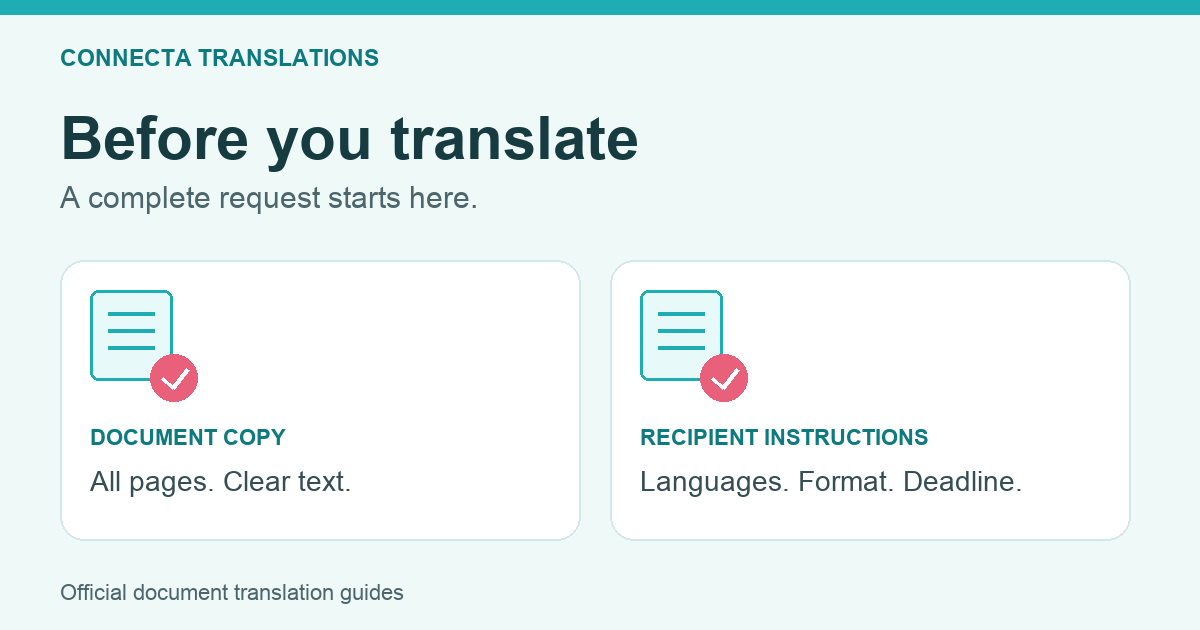
Gather the complete source document, the recipient’s translation instructions, the required language, and your deadline. A document name alone rarely gives a provider enough information to confirm the work.
Use a short project note that answers four questions: Who will receive this? What language is it in? What language must it be translated into? When do you need the finished package in hand?
If several documents belong to the same application, list them separately. For example, a hypothetical request might include a two-sided civil record and a three-page school transcript. That is five sides to inspect, even if the request describes only two documents. A page inventory helps both you and the provider notice omissions early.
How do you make a readable scan or photograph?
Capture the entire page with all four edges visible, even lighting, and sharp text. Review the saved file at normal reading size before sending it. A file that looks clear as a thumbnail may hide a blurred stamp or clipped line.
- Place the page flat against a plain background.
- Keep the camera parallel to the page to reduce distortion.
- Avoid glare, shadows, fingers over text, and cropped edges.
- Check small print, handwritten entries, stamps, and registration numbers.
- Scan each page in order and confirm that the final file opens.
- If one area remains unclear, send the full page plus a clearly labeled close-up.
These are practical preparation recommendations, not a universal agency specification for resolution or file size. Ask the receiving office about its own submission limits and the provider about its accepted upload formats.
Do you need to include the back of the document?
Inspect both sides and include any side containing text, stamps, endorsements, or notes. Also check attachments and continuation pages. If you are unsure whether a blank reverse side must be submitted, ask the receiving office rather than guessing.
For USCIS submissions, 8 CFR 103.2(b)(3) requires a full English translation of a document containing foreign language, with the specified translator certifications. Preparing a complete source copy helps the translator see what must be addressed.
Use the existing birth certificate and marriage certificate guides for more context on those records. Keep current recipient instructions with your working checklist.
How should you handle names, dates, and unclear handwriting?
Leave the source document unchanged. Put questions in a separate note and let the translator assess the text. Do not digitally replace a name, erase an entry, or rewrite a date on the source scan.
If other records use a different spelling of your name, mention that difference and provide the relevant context through the provider’s agreed process. Reference information can help identify a question; it is not permission to silently change what the original says.
For an unclear handwritten word, identify its location, such as “page 2, lower-left note.” If possible, supply a sharper scan. Do not present a guessed reading as confirmed. A provider should explain how unresolved illegibility will be represented, and the recipient may need to advise you about obtaining a clearer source.
Keep ambiguous dates visible too. If a numeric date could be read in different orders, flag it for review rather than converting it yourself. Small preparation notes often make a more useful inquiry than a long explanation of the whole application.
What instructions should accompany an academic document?
Send the requirements of the university, evaluator, licensing board, or other recipient. A translation request and a credential evaluation request may involve separate steps, so clarify who needs which documents and how they must arrive.
Ask whether the recipient needs every term, grading explanation, reverse-side note, or accompanying diploma. Also ask whether it requires records directly from the school. A translator’s completed file should not be treated as a substitute for an institution’s required document-delivery process.
Connecta’s academic translation services and school transcript translation guide can help you frame the request. Include the recipient’s instructions rather than relying on a checklist intended for another institution.
What belongs in a complete quote request?
A clear request gives the provider enough information to assess the document and propose a specific scope. Keep administrative details separate from sensitive personal background that is unrelated to the translation.
| Include | Why it helps |
|---|---|
| All document pages and relevant sides | Shows the complete work to review |
| Source and target languages | Confirms the translation direction |
| Receiving office and instructions | Defines certification and delivery requirements |
| Deadline and time zone | Distinguishes completion from arrival |
| Digital or paper delivery needs | Identifies shipping or signature questions |
| Questions about unclear text | Flags issues before work begins |
For example: “Please quote a certified translation of the attached two-page document from [language] into [language] for [recipient]. I need [delivery format] by [date and time zone]. The recipient’s instructions are attached. Page 2 contains a stamp that may need a clearer scan.”
What should you check when the translation arrives?
Check that the delivered package covers the intended document and includes the agreed certification and delivery format. The ATA describes a certified translation package as source text, translated text, and a signed accuracy statement.
Compare the page inventory, names, document numbers, and dates with the source. If you notice a discrepancy, ask the provider to review it. Do not edit the certified translation yourself, since that can leave the certification attached to text the signer did not approve.
Keep the final version clearly labeled and retain the recipient instructions. If the office requests a revision or additional format, send that request to the provider so the changes can be handled consistently.
How do you send your request to Connecta?
Review the certified translation service page, then request a quote with your document inventory, languages, instructions, and deadline. Confirm the appropriate method for providing sensitive files and the expected completion date.
Connecta serves clients from Bradenton, Florida, including Sarasota and Lakewood Ranch. If your instructions mention notarization, ask about it when requesting the quote and review the notary service information. Translation preparation guidance helps organize the language work; the receiving office remains the authority on its submission requirements.
Frequently asked questions
Can I send phone photographs instead of scans?
Ask the provider which formats it accepts. A photograph should show the complete page with readable text, stamps, and notes. Send a clearer image if glare, blur, or cropping hides information.
Should I remove personal information from the source copy?
Ask the provider before redacting anything that may belong in the translation. Avoid sending unrelated records, and use the agreed method for sharing sensitive documents.
What if part of the document is unreadable?
Flag the location and try to obtain a sharper image or a clearer source copy. Ask how the translator will mark unresolved illegibility and whether the recipient needs a replacement document.
Can I correct the translated PDF myself?
Send correction questions to the provider. Editing a certified translation yourself can separate the signed certification from the text the signer approved.
Sources and editorial note
Official and professional sources checked October 13, 2026. The document preparation checklists and sample inquiries are practical editorial guidance. Confirm current requirements with the receiving office.