Certified Translation
Certified vs. Notarized Translation: Which Do You Need?
By Connecta Translations · · 6 min read
A certified translation includes a signed statement about accuracy and completeness. Notarization addresses the signer’s identity, rather than the quality of the translated text. For people preparing immigration, academic, or other official documents, the receiving office’s written instructions determine the service to order. This Connecta Translations guide explains the distinction, the USCIS translation rule, and the questions to resolve before paying for an extra step.
What is the difference between certified and notarized translation?
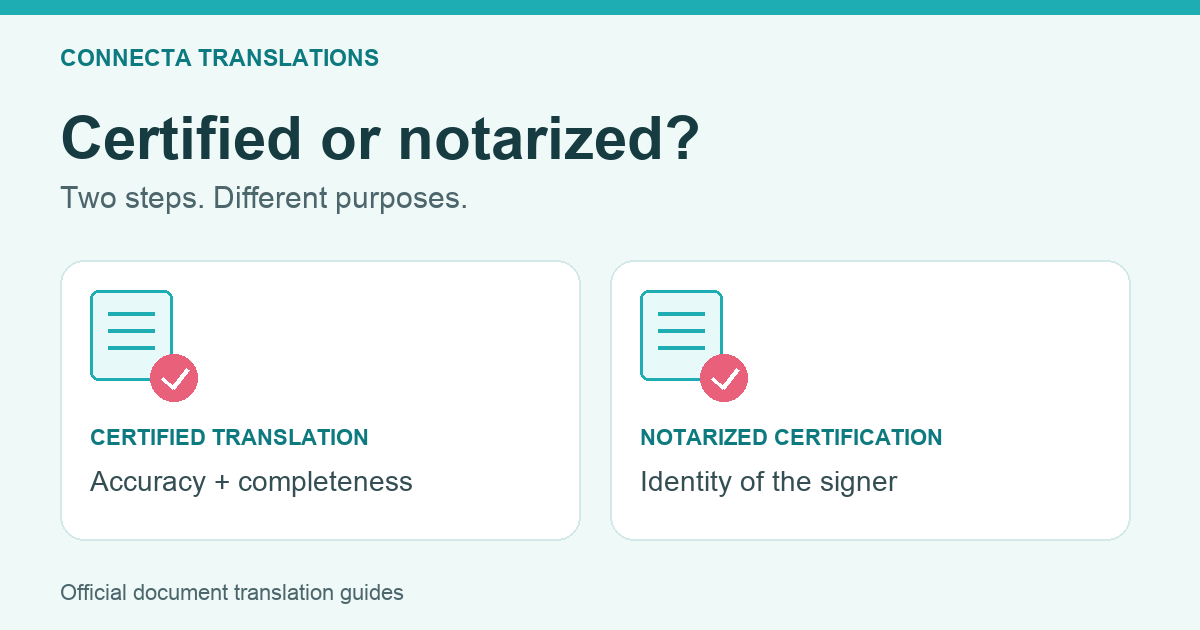
A certified translation addresses the translated content. A notarized certification adds a notarial act concerning the person signing the statement. These serve different purposes; a notary seal does not establish that the translation is accurate.
The American Translators Association explains this distinction. If an office asks for a “notarized translation,” clarify which certification statement it wants notarized and whether it has a required format.
| Service | Main purpose | Question to ask |
|---|---|---|
| Certified translation | Signed assurance of completeness and accuracy | What must the certification include? |
| Notarized certification | Notarial act for the certification signer | Does the office explicitly require notarization? |
Does USCIS require translations to be notarized?
The general USCIS rule in 8 CFR 103.2(b)(3) calls for a full English translation, certification of completeness and accuracy, and certification that the translator is competent to translate into English. It does not add a notarization requirement.
Keep the translation requirement separate from requirements for the underlying document. Follow the current instructions for the particular application and any case-specific request. A translation provider can prepare the language work; questions about immigration eligibility or filing strategy belong with a qualified legal professional.
For document-specific preparation, see Connecta’s birth certificate guide and marriage certificate guide. Use those checklists alongside current official instructions.
Is a certified translation the same as an ATA-certified translator?
No. A certified translation is a document accompanied by a certification statement. ATA certification is a professional credential held by a translator in a specific language combination and direction.
The ATA’s explanation of these terms is useful when comparing providers. Ask about the actual source and target languages of your project rather than assuming a credential covers both directions.
Connecta’s About page identifies Marcela Arenas as an ATA-certified English-into-Spanish translator. Tell Connecta which direction you need so the appropriate service can be confirmed. A Spanish-to-English immigration request and an English-to-Spanish document request should be scoped explicitly.
How do you decide what to order?
Start with the office receiving the document. Save its written requirements and send them with your quote request. The label “official translation” is too broad to settle every detail.
- Name the recipient. Identify the agency, university, court, consulate, or other office and the purpose of the submission.
- Confirm the translation direction. State the language of the source and the required language of the translation.
- Ask about certification. Check for prescribed wording, translator credentials, signatures, or letterhead.
- Ask about notarization separately. Request an explicit answer if the instructions are unclear.
- Confirm delivery. Find out whether a digital file is enough or a paper package must reach the office by a deadline.
These are ordering questions, not a promise of acceptance. The recipient makes the final decision about its requirements.
What should you ask before paying for additional services?
Ask for a quote that separates translation, notarization if requested, and delivery. This makes it easier to compare the same scope across providers.
A useful inquiry is: “I need this document translated from Spanish into English for [office]. The attached instructions say [requirement]. Please confirm the certification, any notarization, delivery format, total cost, and expected completion date.” This is a sample inquiry, not a client story.
Do not assume the same document will have the same requirements everywhere. If a diploma is going to two institutions, send both sets of instructions. If one office gives a vague answer, resolve that uncertainty before arranging an extra signature or shipment.
How can Connecta help you prepare the right request?
Use Connecta’s certified translation service page to describe the language work you need. If the recipient specifies notarization, review the notary service page and ask about that step in the same inquiry. For immigration-related documents, the immigration translation page provides a service starting point.
Clients in Bradenton, Sarasota, Lakewood Ranch, and elsewhere can request a quote with the complete document, recipient instructions, and deadline. Confirm the scope and turnaround with Connecta before making filing or delivery arrangements.
Frequently asked questions
Does a notary verify translation accuracy?
No. Notarization concerns the certification signer, rather than a linguistic review of the translation. The translator’s certification addresses accuracy and completeness.
Do I need both certification and notarization?
Only order both when the receiving office’s requirements call for both. Send its written instructions to the provider so the quote covers the correct scope.
Does USCIS require an ATA-certified translator?
The general rule in 8 CFR 103.2(b)(3) requires a competent translator and the specified certifications. It does not require ATA certification. Check current application instructions and any case-specific request.
Can one translation package be used for two offices?
Compare both offices’ requirements before relying on one package. Their certification wording, notarization, and delivery requirements may differ.
Sources and editorial note
Official and professional sources checked October 13, 2026. The document preparation checklists and sample inquiries are practical editorial guidance. Confirm current requirements with the receiving office.