Why does the receiving agency matter?
The instructions attached to your current submission determine which translation rule to follow. Do not assume that a document prepared for an earlier stage will meet every requirement at a later stage.
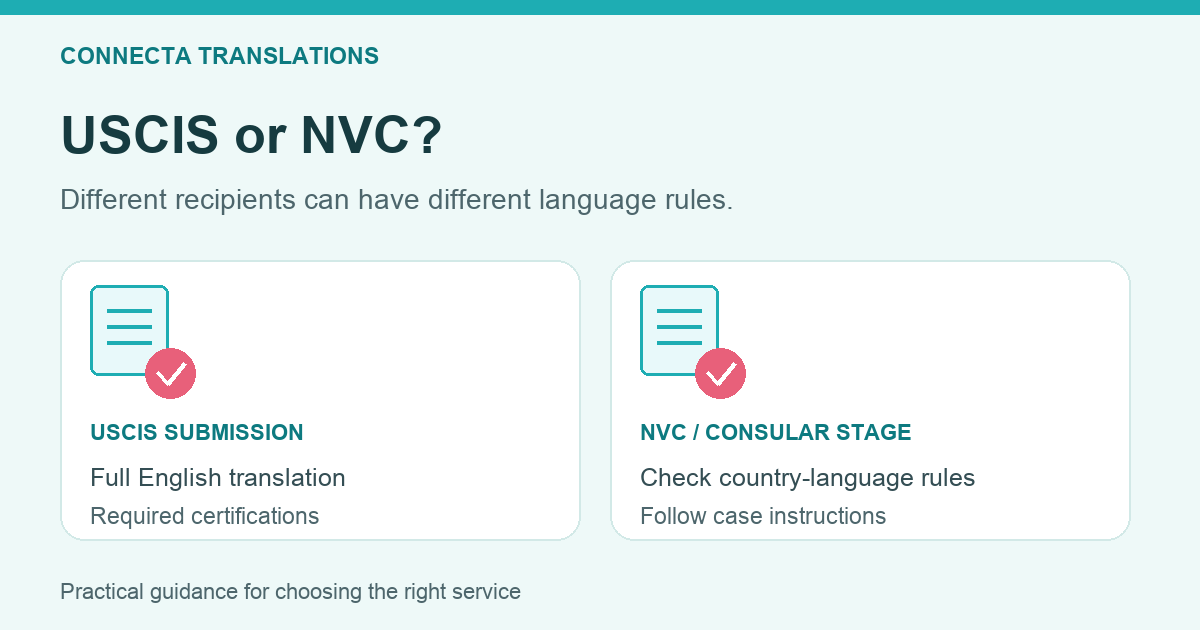
USCIS’s general translation rule and the Department of State’s civil document guidance use different language. Understanding that distinction can help you ask an accurate question before buying another translation.
Identify the agency, form or case stage, and actual office that will receive the record. If your notice or case instructions are unclear, ask the relevant office or a qualified immigration adviser to clarify them.
What is the general rule for documents submitted to USCIS?
Under 8 CFR 103.2(b)(3), a document containing foreign language submitted to USCIS must have a full English translation. The translator must certify completeness and accuracy and competence to translate into English from the source language.
This general provision does not add a notarization or ATA-certification requirement. Follow the current form instructions and any case-specific request as well. The rule concerns translation; it does not resolve whether the underlying record is the right evidence for your application.
For related document preparation, see Connecta’s birth certificate, marriage certificate, and divorce decree guides.
How does the Department of State describe the NVC requirement?
The Department of State’s Step 7 guidance calls for certified translations when documents are not written in English or in the official language of the country from which you are applying. Its guidance also calls for a signed translator statement about accuracy and competence.
That country-language condition is why the USCIS rule should not simply be copied into every discussion of consular processing. A document that needs an English translation for a USCIS filing may be assessed under a different language instruction at the immigrant visa stage.
Check the current country-specific document information and embassy or consulate instructions. Do not use this general comparison to disregard an explicit request in your case.
Can you reuse a translation from an earlier stage?
Compare the actual package with the new recipient’s requirements before deciding. Check that it concerns the correct source record, covers the intended document, and includes the requested certification and delivery format.
A previous submission or acceptance is useful background, not a guarantee for another office. If the underlying record has been replaced, amended, or supplemented, tell the provider. Ask whether the existing translation still matches the record you intend to submit.
Do not alter a certified translation yourself to make it look current or to add a missing attachment. Ask the provider to assess the new request and confirm its scope. Questions about which record is legally appropriate belong with the receiving office or your adviser.
Which questions help prevent ordering the wrong service?
Before requesting a quote, identify the current recipient and collect its written checklist. Keep decisions about the language service separate from decisions about eligibility or filing strategy.
- Name the agency and submission stage.
- Identify the document and its issuing country.
- Confirm the required target language.
- Share the current certification and delivery instructions.
- List any later interview or paper-document requirement.
- State the date you need the translation in hand.
If two offices need the record, describe them separately. A single request that only says “for immigration” can leave the provider without the information needed to confirm the right scope.
How can Connecta help with the translation request?
Review Connecta’s immigration translation services and certified translation services, then request a quote with the recipient instructions and language direction.
Connecta provides document translation services from Bradenton, Florida, for clients in Sarasota, Lakewood Ranch, and elsewhere. The translation request can be scoped around the record and instructions you provide. This does not establish eligibility, replace immigration advice, or guarantee an agency outcome. Use the preparation checklist to organize the source records before sending your inquiry.
Frequently asked questions
Are USCIS and NVC translation requirements identical?
No. USCIS’s general rule calls for full English translations of foreign-language documents submitted to it. The Department of State’s immigrant visa guidance includes a condition involving English and the official language of the country from which you apply.
Does NVC always require every civil document to be translated into English?
Do not assume a universal English-only requirement. Check the Department of State’s current guidance, country-specific information, embassy instructions, and any explicit case request.
Does a previous acceptance guarantee that another office will accept the translation?
No. Compare the new recipient’s requirements and the exact source record before reusing an existing package.
Can Connecta tell me which immigration application to file?
This guide concerns the translation service. Questions about eligibility, filing strategy, and the legal sufficiency of evidence belong with a qualified immigration adviser.
Sources and editorial note
Official and professional sources checked November 13, 2026. Checklists and examples are practical editorial guidance. Confirm current requirements with the receiving office.