What is the difference between translation and credential evaluation?
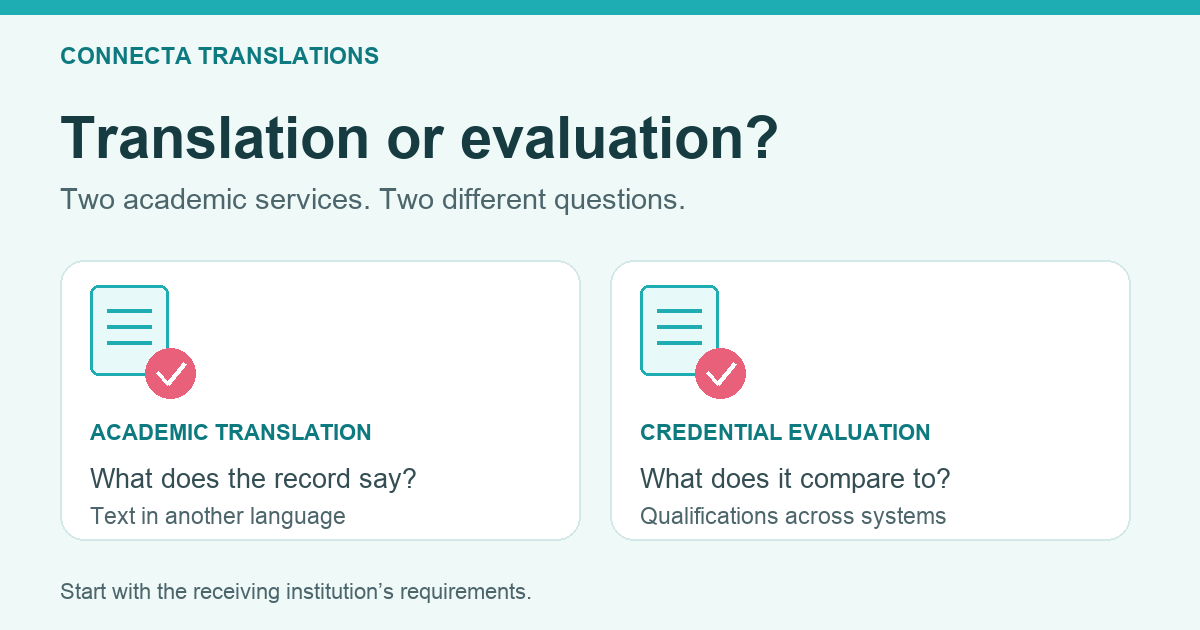
A translation makes the wording of an academic record accessible in another language. An evaluation analyzes what the qualification represents in a different education system. Translating a degree title does not, by itself, establish its U.S. equivalency.
Educational Credential Evaluators (ECE) describes credential evaluation as a comparison of academic and professional degrees earned in different countries. The final recipient decides what evidence it needs for admission, employment, or licensing.
| Question | Academic translation | Credential evaluation |
|---|---|---|
| What does it explain? | What the source record says | How the qualification compares in another system |
| What do you receive? | Translated text, with certification if requested | An evaluation report of the required type |
| Who defines the scope? | The recipient’s translation instructions | The recipient’s evaluator and report requirements |
Who decides whether you need one service or both?
Ask the office that will make the decision about your application. A university admissions office, an employer, and a licensing board may each request different materials from the same graduate.
Before ordering, get answers to these questions:
- Do you require a translation, an evaluation report, or both?
- Which evaluation providers and report types do you accept?
- Must academic records arrive directly from the issuing institution?
- Who may translate the records, and is a signed certification required?
- Where should the translation and evaluation report be delivered?
Keep the written answers with your application checklist. An evaluator’s acceptance of a translation does not automatically mean a separate university or licensing board will accept the same package.
Do WES and ECE have the same translation rules?
No. Compare the specific evaluator’s current instructions before hiring a translator or preparing your own version. The examples below show why one checklist cannot cover every evaluation.
World Education Services (WES) says that U.S. evaluations require translations of documents issued in languages other than English. Its published guidance requires professional, complete, legible translations and excludes applicant-prepared translations. Check your account’s required-document list and its rules about the official records used for translation.
ECE’s translation FAQ permits applicant-prepared translations when they are word-for-word and follow the original format. ECE also offers a Translation Waiver option for eligible orders; the waiver is unavailable for NABP orders, which have separate documentation instructions. Without the waiver, ECE generally requires English translations of non-English documents.
These are examples of different provider policies, not endorsements or a promise that a particular translation will be accepted. Confirm the rules for your exact country, credential, report, and recipient before placing an order.
Does a translated transcript need converted grades?
Do not replace the source grades with your own U.S. letter grades or GPA calculation. Ask the translator to convey the record faithfully, including the grading legend when it is part of the document. Ask the evaluator or final recipient who should perform any equivalency calculation.
For example, imagine a transcript containing a numerical mark and a separate page explaining the institution’s scale. A translation should make both pieces understandable. Inserting an assumed U.S. letter grade could blur the difference between reporting the original result and evaluating it. This is a hypothetical example, not a client case.
Also flag course abbreviations, degree titles, and unclear handwritten entries. Provide context in a separate note rather than rewriting the source record. Use Connecta’s school transcript translation guide for document preparation alongside the actual recipient instructions.
How should you coordinate official records and translations?
Plan two document paths: the records the school must send and the material the translator needs to read. Do not open a sealed envelope intended for an evaluator without checking its instructions.
WES distinguishes official-document delivery from translation upload. Its guidance says translations can be uploaded through the applicant account and do not need a sealed envelope. That does not replace the separate requirements for official academic records.
ECE explains that if you do not know what is inside a sealed envelope, you can request two sets so one may be opened for translation. Confirm the appropriate approach for your order rather than assuming a scan in your possession matches the official version.
- Obtain the recipient’s checklist and the evaluator’s country-specific requirements.
- List each diploma, transcript, attachment, and reverse side.
- Confirm how the translator will access the correct source records.
- Arrange the school’s required delivery separately.
- Track translation completion and evaluation delivery as separate milestones.
What should an academic translation quote include?
Ask for a quote tied to the actual records and recipient instructions. Include the source and target languages, complete page count, required certification, deadline, and digital or paper delivery needs.
A useful sample request is: “I need my diploma and transcript translated from [language] into English for [recipient and evaluator]. Their instructions are attached. Please confirm the source records you need, certification, delivery format, cost, and expected completion date.”
Keep evaluation fees and translation fees separate when comparing options. A translation quote should not be read as including a credential evaluation unless that service is explicitly offered and confirmed. Connecta does not promise a universal price, completion time, or institutional outcome in this guide.
How can Connecta help with academic document translation?
Review Connecta’s academic translation services and certified translation services, then request a quote for the language work your recipient requires. Send the evaluator’s instructions so Connecta can confirm the translation direction, certification, and scope.
Connecta is based in Bradenton, Florida, serving clients in Sarasota, Lakewood Ranch, and elsewhere. For a more complete inquiry, use the checklist in How to Prepare Documents for a Certified Translation. Keep decisions about degree equivalency and accepted evaluation reports with the evaluator and receiving institution.
Frequently asked questions
Is an academic translation a credential evaluation?
No. A translation conveys the source record in another language. A credential evaluation compares the qualification across education systems and produces a separate report.
Can I translate my own transcript for an evaluation?
The evaluator’s rules control. WES excludes applicant-prepared translations in its published guidance, while ECE permits them for many orders when they meet its requirements. Confirm the rules for your specific order and final recipient.
Should a translator convert my grades to a U.S. GPA?
Do not assume grade conversion is included in translation. Preserve the original grades and grading information, and ask the evaluator or recipient who should perform any equivalency calculation.
Will a certified translation replace official school records?
No. A translated file does not replace a requirement for official records sent by the issuing institution. Follow the recipient’s separate instructions for records, translations, and evaluation reports.
Sources and editorial note
Official and professional sources checked October 26, 2026. Checklists and examples are practical editorial guidance. Confirm current requirements with the receiving office.